 how-to
Do You Need a Permit for Solar Panels in Florida?
Last Updated: October 26, 2026
Quick Summary
The residential solar permit process in Florida starts with your local building department and ends with a utility sign-off. Most rooftop jobs pull building, electrical, and sometimes photovoltaic permits, and a realistic timeline runs four to twelve weeks from application to permission to operate.
- Missing paperwork is the number one cause of permit delay, so gather documents early.
- Signed and sealed plans from a Florida-licensed engineer are required in many jurisdictions.
- Installation itself is fast, often one to three days for a residential rooftop system.
- Utility interconnection and permission to operate can take two to six weeks.
- A correction notice is not a denial; resubmit with a response letter addressing each item.
Table of Contents
- Do You Need a Permit for Solar Panels in Florida?
- Florida Solar Permit Requirements by System Type
- Solar Panel Permit Application Documents You'll Need
- The Florida Solar Permit Timeline, Start to Finish
- The Solar Panel Inspection Process and Utility Approval
- Get Your Free Solar Audit Before You File a Permit
- Frequently Asked Questions
Do You Need a Permit for Solar Panels in Florida?
Yes. Florida requires permits for almost every residential solar install, and skipping that step is not an option.
Here is the honest part most homeowners learn too late: the permit is not the finish line.
At Solar Power Auditing, our free audit shows what your roof can actually produce before anyone files a single form.
Below, we break down the requirements, the documents, and the real timeline.
Florida Solar Permit Requirements by System Type
Not every solar project needs the same approvals. A rooftop photovoltaic system, a solar pool heater, and a solar hot water heater follow different paths. The Florida solar permit requirements depend on what you install and where you live.
Building, Electrical, and Photovoltaic Permits
Most rooftop solar jobs pull three permits at once:
- Building permit for structural work and roof mounting
- Electrical permit for wiring, inverters, and disconnects
- Photovoltaic permit where your county issues a separate solar permit
Some building departments bundle these into one application. Others want them filed separately. A common mistake is filing only the electrical permit and getting a correction notice two weeks later.
Local Jurisdiction and County Variations
Every county permitting office runs its own rules.
City jurisdictions inside a county can add another layer. If your home sits inside city limits, check with both the city and the county before you file.
Florida Building Code solar provisions sets the baseline, but local amendments decide the details.
Solar Panel Permit Application Documents You'll Need
Missing paperwork is the number one cause of permit delay. The solar panel permit application documents are predictable, so gather them early, but expect the exact packet to shift by jurisdiction. A Broward County submittal and a rural county submittal can share 80% of the same pages and still differ on notarization, wind-load forms, and product approval documentation.
Here is a homeowner-ready checklist organized by who produces each item:
Owner-provided
- Completed permit application with owner signature (a contractor cannot sign for you)
- Notarized owner authorization, if your jurisdiction requires it
- Property survey or legal description, if requested
Contractor- or engineer-provided
- Contractor signature and state license number
- Signed and sealed plans from a Florida-licensed engineer
- Site plan showing panel layout, setbacks, and roof access pathways
What a Complete Plan Set Actually Contains
A sealed plan set is not one drawing. Most reviewers expect a cover sheet with the system summary and code edition, a roof plan with panel layout and dimensions, an electrical single-line diagram, a structural or attachment detail sheet, and equipment specification sheets.
A common pattern is for homeowners to submit a sales proposal in place of a plan set. A proposal shows production estimates and a price; a plan set shows how the system attaches, wires, and disconnects. They are not interchangeable.
Signed and Sealed Plans and Owner Signatures
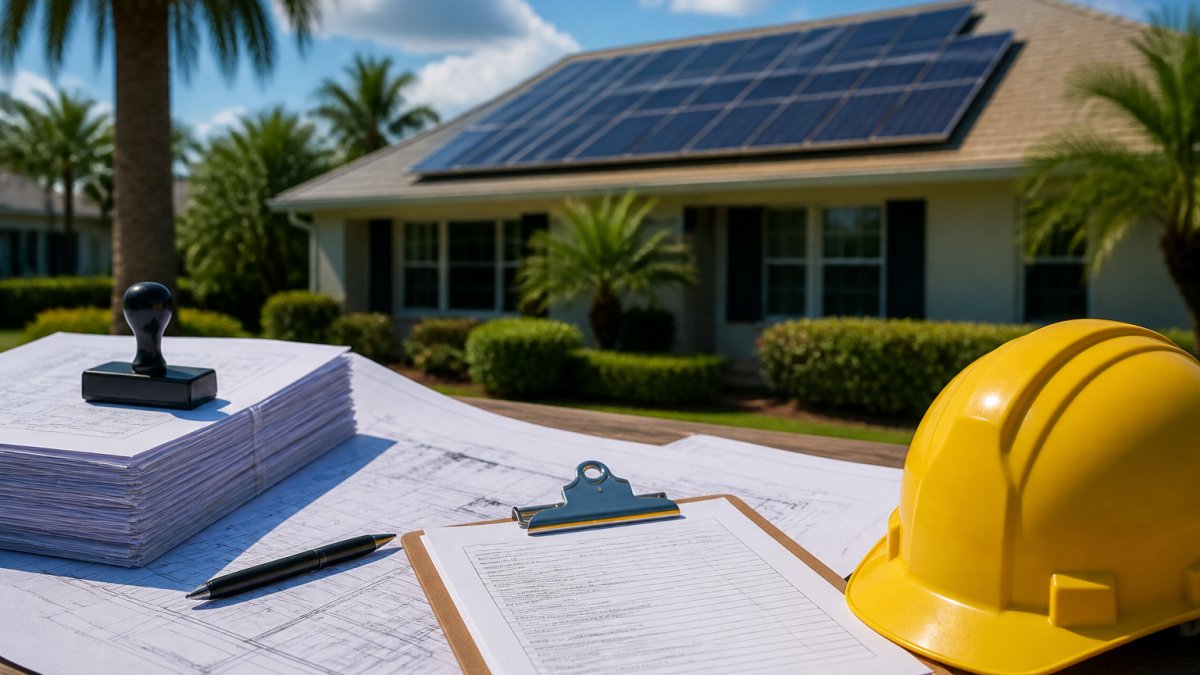
Signed and sealed plans are technical blueprints stamped by a Florida-licensed engineer. Many jurisdictions will not review a solar application without them.
The owner signature matters too. Some counties require a notarized application, and a contractor cannot sign for you. If you plan a DIY installation, expect extra scrutiny on the electrical and structural drawings, and expect some jurisdictions to require an owner-builder affidavit before they will accept the submittal.
When the Packet Is Incomplete: Correction Notices and Resubmission
A correction notice is not a denial. It is a list of items the reviewer needs before the application can move forward. The practical recovery steps are consistent across most jurisdictions:
- Read every item on the notice and map each one to a specific page in the plan set.
- Have the engineer or contractor revise the drawings and re-seal them if the change is structural or electrical.
- Resubmit the corrected packet with a response letter that addresses each item by number.
- Ask whether the resubmission goes to the back of the review queue or returns to the same reviewer, this varies and affects your timeline.
If an application is formally denied rather than corrected, ask the building department for the appeal path in writing. Most jurisdictions have a board of adjustment or appeals process with a filing deadline, and missing that deadline can force a full resubmittal.
The Florida Solar Permit Timeline, Start to Finish
A realistic Florida solar permit timeline runs four to twelve weeks from application to permission to operate. The permit itself is only one slice of that, and the utility interconnection step is often the longest single wait.
Here is how the stages break down:
| Stage | Typical Duration | Who Handles It |
|---|---|---|
| Application prep and sealed plans | 1-2 weeks | Installer and engineer |
| Building department review | 1-4 weeks | County or city |
| Installation | 1-3 days | Licensed contractor |
| Inspection and correction | 1-2 weeks | Inspector and contractor |
| Utility interconnection and permission to operate | 2-6 weeks | Utility company |
Correction notices stretch every stage. An incomplete application can sit in review for weeks before anyone flags the missing page, which is why the document checklist above matters more than any single timeline estimate.
Expedited Permitting and Automatic Approval Rules
Florida has moved toward faster solar approvals through state-level expedited permitting requirements that apply to qualifying residential rooftop systems. The practical effect is that some jurisdictions must review and approve a complete, qualifying application within a short statutory window, often measured in business days rather than weeks, and some use automated or electronic review portals for standard residential systems.
Eligibility usually hinges on four factors:
- System type and size, standard residential rooftop photovoltaic systems generally qualify; ground-mounted, commercial, and non-standard designs often do not.
- Code compliance, the design must meet the current Florida Building Code and the adopted electrical code.
- Complete documents, the expedited clock typically starts only when the jurisdiction deems the application complete, not when it is first submitted.
A Stage-by-Stage View of Where the Weeks Go
Permitting is not one wait; it is several. Application prep depends on how fast the engineer can produce sealed plans. Building department review depends on the jurisdiction's queue and whether your packet is complete on the first pass.
A common pattern is for homeowners to budget for the permit review and forget the utility step.
If you have questions about how the whole process fits together, our team offers straight answers on quotes, roofs, and installation.
The Solar Panel Inspection Process and Utility Approval
The solar panel inspection process is where good projects get held up.
Expect these checks:
- Structural inspection of mounts and roof penetrations
- Electrical inspection of grounding, disconnects, and labeling
- Final inspection covering the whole system
An inspector who finds a problem issues a correction notice. Your contractor fixes it and schedules a re-inspection.
Then comes utility interconnection. Your utility reviews the application, approves the meter setup, and grants permission to operate.
Want to see what finished, permitted work looks like? Browse real installs from across the state.
Get Your Free Solar Audit Before You File a Permit
The smartest move is to size the system correctly before anyone touches a permit application. A wrong-sized array means amended plans, a second review, and lost weeks.
That is exactly what our audit prevents. You can see how a free solar audit works, from roof and bill details to a custom design and written quote. When you are ready, get your free solar quote and a solar advisor will follow up.
Frequently Asked Questions
Do I need a permit to install solar panels in Florida?
Yes. A residential solar permit is required for nearly every rooftop photovoltaic system in Florida, and most projects need building, electrical, and photovoltaic approvals. Skipping the solar permit risks failed inspections, fines, and problems at resale. Local building departments enforce these rules, so confirm the exact requirements with your county permitting office before any work begins.
Who applies for a solar permit, the homeowner or the installer?
Either can apply, but the licensed contractor usually files the solar panel permit application on the homeowner's behalf and signs the electrical and structural portions. Homeowners filing as do-it-yourselfers must sign the application themselves and supply signed and sealed plans from a Florida-licensed engineer. Confirm who is listed as the applicant before submission so the building department routes review correctly.
How long does it take to get a solar permit in Florida?
Review timelines vary by jurisdiction, but many counties issue standard residential solar permits within a few weeks, and some expedited programs aim for next-business-day issuance when the application is complete. Incomplete applications trigger correction notices that reset the clock. Build in extra weeks for structural review or resubmission, then add installation, inspection, and utility interconnection before the system can operate.
What happens after a solar inspection is passed?
After the final inspection passes, the building department closes the permit, and your installer submits the signed-off paperwork to the utility for interconnection. The utility then grants permission to operate, which is the point where the system can legally send power to the grid. Only then should you expect bill reductions. Keep copies of the inspection record and permission-to-operate letter for warranty and resale files.
A permit is only as good as the design behind it. If your roof is shaded, aging, or the numbers do not add up, you deserve to know before you file. Solar Power Auditing gives you an honest assessment, a customized system design based on your roof and usage, and a written quote with projected savings. We also handle the paperwork, permits, and installation through one licensed local installer. Get started with Solar Power Auditing and find out what your roof can really do.